ONTOLOGY
Your business concepts. Automatically modeled
zaimler reads across all data sources and automatically infers a Unified Domain Model.
WHY THIS EXISTS
With no model, your AI guesses
An agent does not know that a policy joins to a claim through an undocumented table, or that the same customer in Salesforce and SAP is one company. A confident wrong guess can result in high costs and unhappy customers.
HOW IT WORKS
Suggest the ontology
Suggest, understand, map, and trace
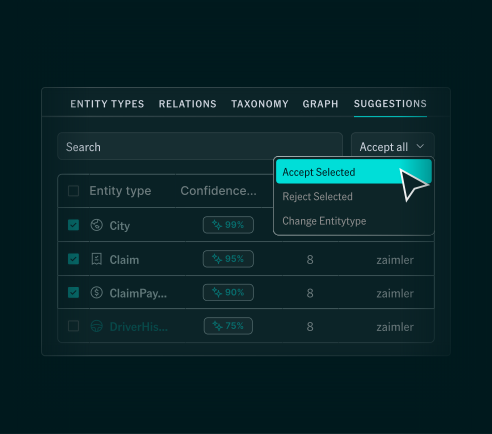
zaimler proposes the entity types from your data, each with a confidence score. Accept them in bulk or one at a time.
Suggest the ontology
zaimler proposes the entity types from your data, each with a confidence score. Accept them in bulk or one at a time.
Understand the reasoning
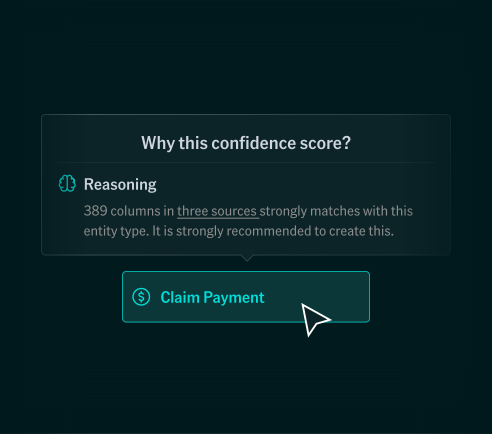
Every suggestion shows the top datasets and columns that drove its confidence score.
Map the model
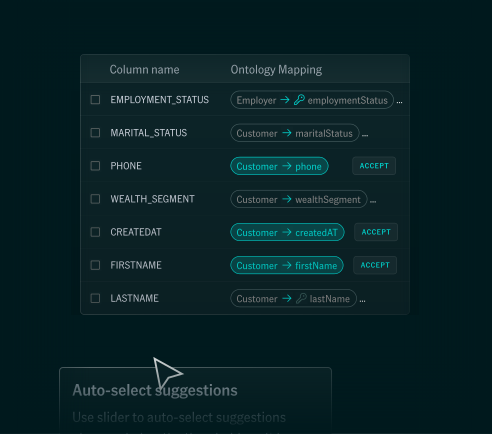
See every source-to-domain mapping. Accept, adjust, or auto-approve mappings above your confidence threshold
Trace it in the model
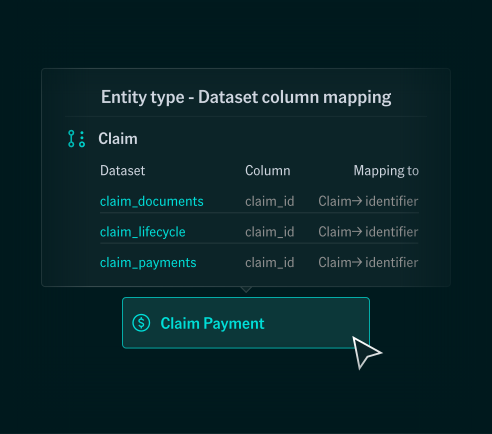
Open any entity and see it fully mapped: exactly which datasets and columns resolve to its identifier.
WHAT'S DIFFERENT
A model grounded in your business domain
Unified Domain Model
One typed model of your business, confirmed by the people who own the data.
Schema Inference
Automatically infers typed entities from your schemas and relationships
Typed Entity Model
One field across multiple systems. Each defined once.
Automatic Source Mapping
Each source column maps onto the model. Accept, adjust, or auto-select every mapping above a threshold.
Entity Resolution
The same customer across two systems resolves to one node, matched on shared identifiers.
Human-Confirm Loop
Your people confirm only the ambiguous calls. Each suggestion shows the reasoning behind its score.
Metadata & Lineage
Every entity carries its mapping: the datasets, columns, source rows behind it, model version, and ingestion time.
Versioning & History
The model is versioned, so you can see what an entity meant and when it changed.
FAQ
One typed model of your business: entities (Customer, Policy, Claim) and relationships, inferred from your data, confirmed by your people, reasoned on by your agents.
zaimler reads your schemas and the relationships in them, infers a typed model, resolves every source onto it, and brings the hard calls back to your team.
No. zaimler infers the model from your sources itself. Your people confirm the ambiguous definitions; they never hand-build or maintain anything.
A graph database is storage. Vector search returns lookalikes. zaimler infers the model, resolves real entities, follows real relationships, so the answer holds.
Days to weeks, where a hand-built, consultant-led model of the same scope runs about a year.
NEXT STEPS
Here's what we can get done with zaimler in just 60 days proof of value
Forward Deployed
Forward-deployed zaimler specialists partner with your in-house experts
Security, issuer, and client data unified into one governed domain
Department-level onboarding begins
Initial consultation
Working session to map use cases and ROI
Pick one high-value workflow: portfolio intelligence, real assets, or client reporting
Go/no-go decision
Delivering real value
Verify the unified domain model inferred by Zaimler
Agents running critical workflows with full audit trails
Measurable ROI from day one — your organizational capacity begins to scale
Forward Deployed
Forward-deployed zaimler specialists partner with your in-house experts
Security, issuer, and client data unified into one governed domain
Department-level onboarding begins
Initial consultation
Working session to map use cases and ROI
Pick one high-value workflow: portfolio intelligence, real assets, or client reporting
Go/no-go decision
Delivering real value
Verify the unified domain model inferred by Zaimler
Agents running critical workflows with full audit trails
Measurable ROI from day one — your organizational capacity begins to scale